
Technical solution for anvil-surface agarwood induction: a sustainable direction for the agarwood industry
VAWA - In the context of the agarwood industry transforming towards professionalism and sustainability, many new technical models have been researched and applied to optimize economic value per unit of cultivated tree. One of the notable methods currently is the “mặt đe” agarwood induction technique – a solution that focuses on harvesting the tree stump after the main trunk has been harvested, opening up a long-term direction for Aquilaria growers.
Anvil-face agarwood creation technical solution: a sustainable direction for the agarwood industry
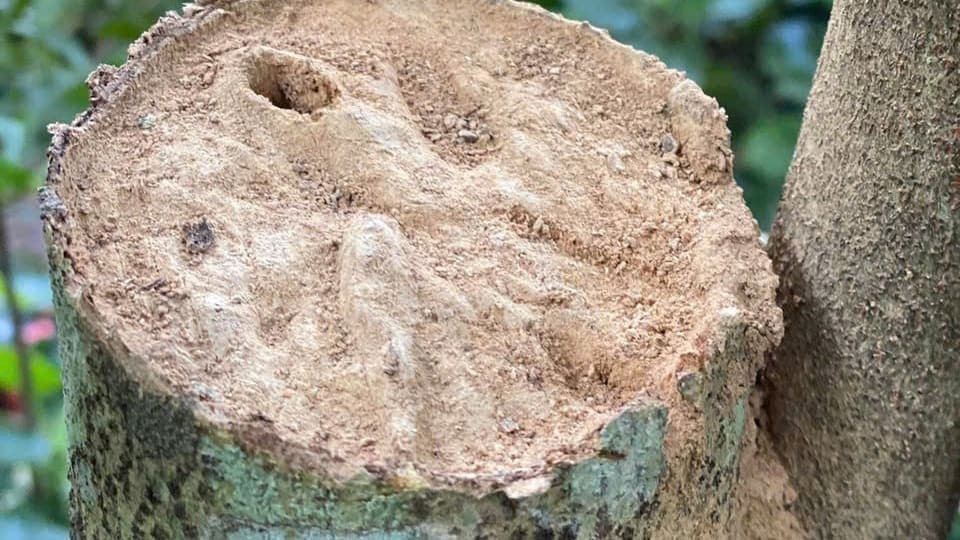
In the context of the agarwood industry transforming towards professionalism and sustainability, many new technical models have been researched and applied to optimize economic value on the same unit of crop. One of the notable methods today is the "anvil-face" agarwood creation technique – an extraction solution focusing on the tree stump after harvesting the main trunk, opening a long-term path for Aquilaria crassna growers.
Utilizing the "stump" to create new value
Unlike traditional harvesting methods that usually end the tree's life cycle after felling the trunk, the anvil-face agarwood creation technique focuses on the tree stump, at a height of 50 to 100 cm from the ground. This is an area capable of maintaining physiological activity if treated correctly.
The core goal of this method is to create a stable, long-term source of income from the remaining stump itself, instead of having to replant completely. This is particularly significant in the context of increasing agarwood investment costs and long payback periods.
Activating regeneration – a stepping stone for the agarwood creation process
Before harvesting the main trunk, growers need to actively stimulate the tree to sprout buds near the base. The formation of new leaves plays an important role in maintaining photosynthesis, ensuring the sap continues to flow.
According to experts, this is the key factor that provides energy for the biochemical reactions taking place at the cut surface – where it will be treated to create agarwood later.
Creating the cut surface and technical "rest period"
After cutting across the trunk, the stump is kept at an appropriate height. A noteworthy technical detail is the waiting time of 1–2 hours for the wood surface to dry naturally. This rest period helps stabilize the vascular bundles, limits sap overflow, and creates favorable conditions for biological preparations to penetrate deep into the wood structure.
Activating biochemical reactions with enzymes
The essence of the agarwood creation process is the tree's self-defense reaction against adverse impacts. In the anvil-face technique, specialized enzyme preparations are used to "activate" this mechanism.
When diluted in appropriate proportions and introduced into the newly cut wood area, the enzymes will act on the parenchyma cells before they are completely damaged. This forces the tree to secrete secondary compounds to isolate the affected area – which is the prerequisite for agarwood formation.
Incubation – maintaining a "living" environment for the agarwood creation reaction
One of the stages that determines the effectiveness of the method is the cut surface incubation technique. A mixture of clean soil or fine mud is mixed with the enzyme solution to form a mud paste, which is then used to cover the entire wood surface.
This coating is then wrapped with plastic film to maintain stable humidity – a necessary condition for enzymes to work effectively. At the same time, this protective layer also helps prevent rainwater from washing away the active ingredients and limits the risk of invasion by rot-causing fungi.
Repeated harvesting cycles – creating long-term income
After about 24 months, the accumulated resin compounds reach a certain density, qualifying for harvest. The agarwood-infected wood will be sliced with a thickness of 3–5 cm from the original cut surface.
The special feature of this method is that after each harvest, a new wood surface is exposed and continues to be treated with enzymes to start the next agarwood creation cycle. As a result, an Aquilaria crassna tree can become a "profitable asset" for many consecutive years.
Dual benefits: economic and ecological
Not only bringing clear economic efficiency, the anvil-face agarwood creation technique also contributes to building a sustainable farming model.
First, maintaining regenerative shoots in parallel with the harvesting process helps form a closed ecosystem on the same tree. This minimizes the need for complete felling and replanting, thereby saving costs and protecting resources.
Besides, actively controlling the agarwood creation process helps improve the efficiency and quality of the product, limiting risks compared to natural methods which depend heavily on luck.
A new direction for the agarwood industry
In the context of an increasingly competitive agarwood market with high quality requirements, technical solutions such as anvil-face agarwood creation are considered an inevitable direction. Not only helping growers optimize economic value, this method also opens up the possibility of developing the agarwood value chain in a sustainable, long-term direction.
Researching, perfecting, and replicating the model will be the key for the Vietnam agarwood industry to improve competitiveness, step by step asserting its position in the international market.